

Most AVO workflows make a big assumption: that the subsurface is at most vertically transversely isotropic (VTI) or, in AVAz, linearised HTI. But that assumption breaks down the moment fractures, faults, oblique stress or other effects introduce off-axis symmetry. So here’s how we built an engine that models them.
How we solved triclinic reflection coefficient calculations…
The formulation of this problem is straightforward, but its solution requires solving a coupled system of equations in up to 21 elastic parameters. Schoenberg and Protazio (Schoenberg & Protazio, 1992) devised a systematic way to tackle it but their method has a limitation:
“The formulation is valid as long as the media involved exhibit up-down symmetry relative to the interface between the media”
So we extended the method to truly triclinic media. We are presenting this result at the Anisotropy, AVO, and Seismic Inversion session on Thursday 20 August, 9:15am at IMAGE 2026 and it’s been live on our SaaS platform for a year now.
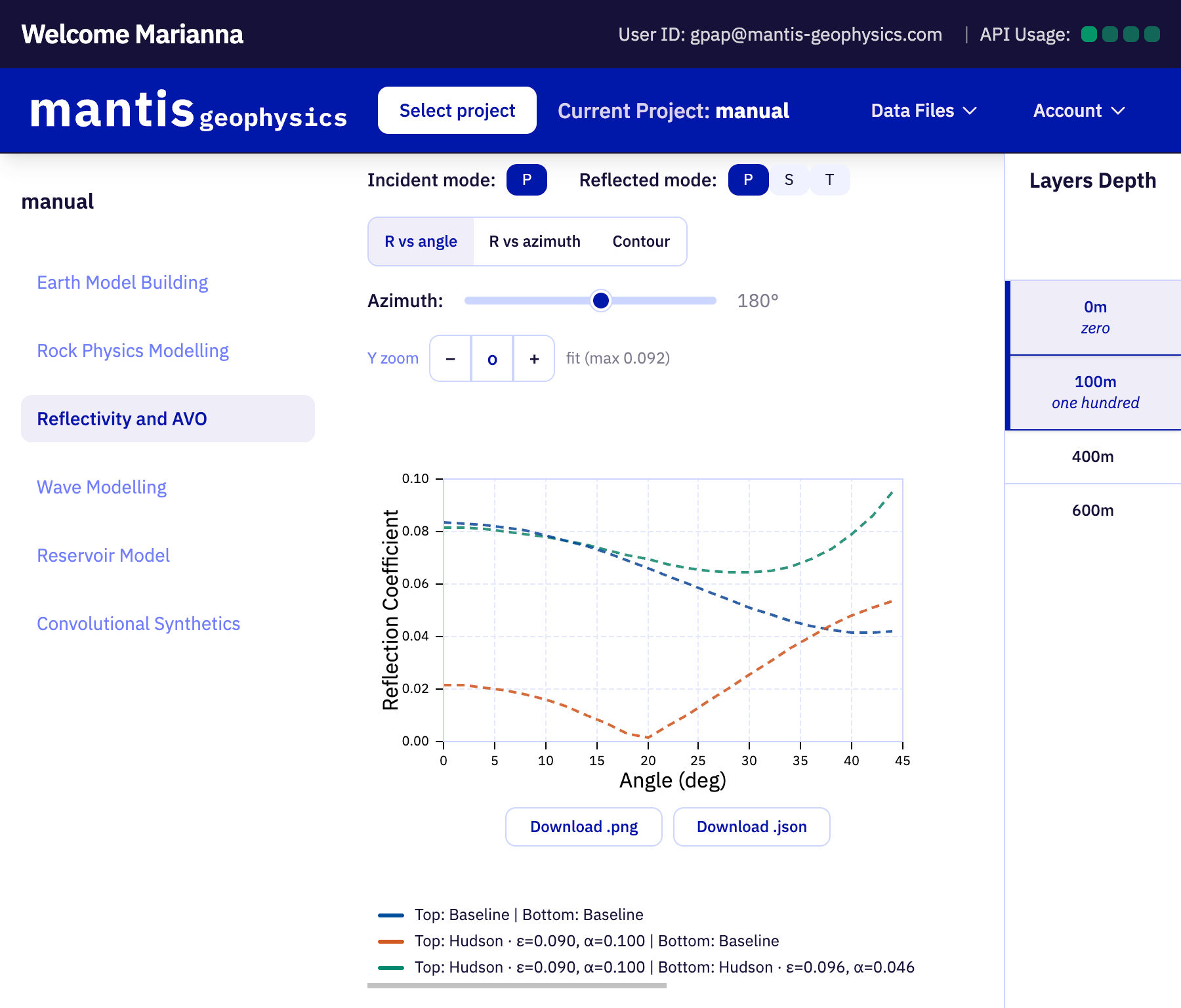
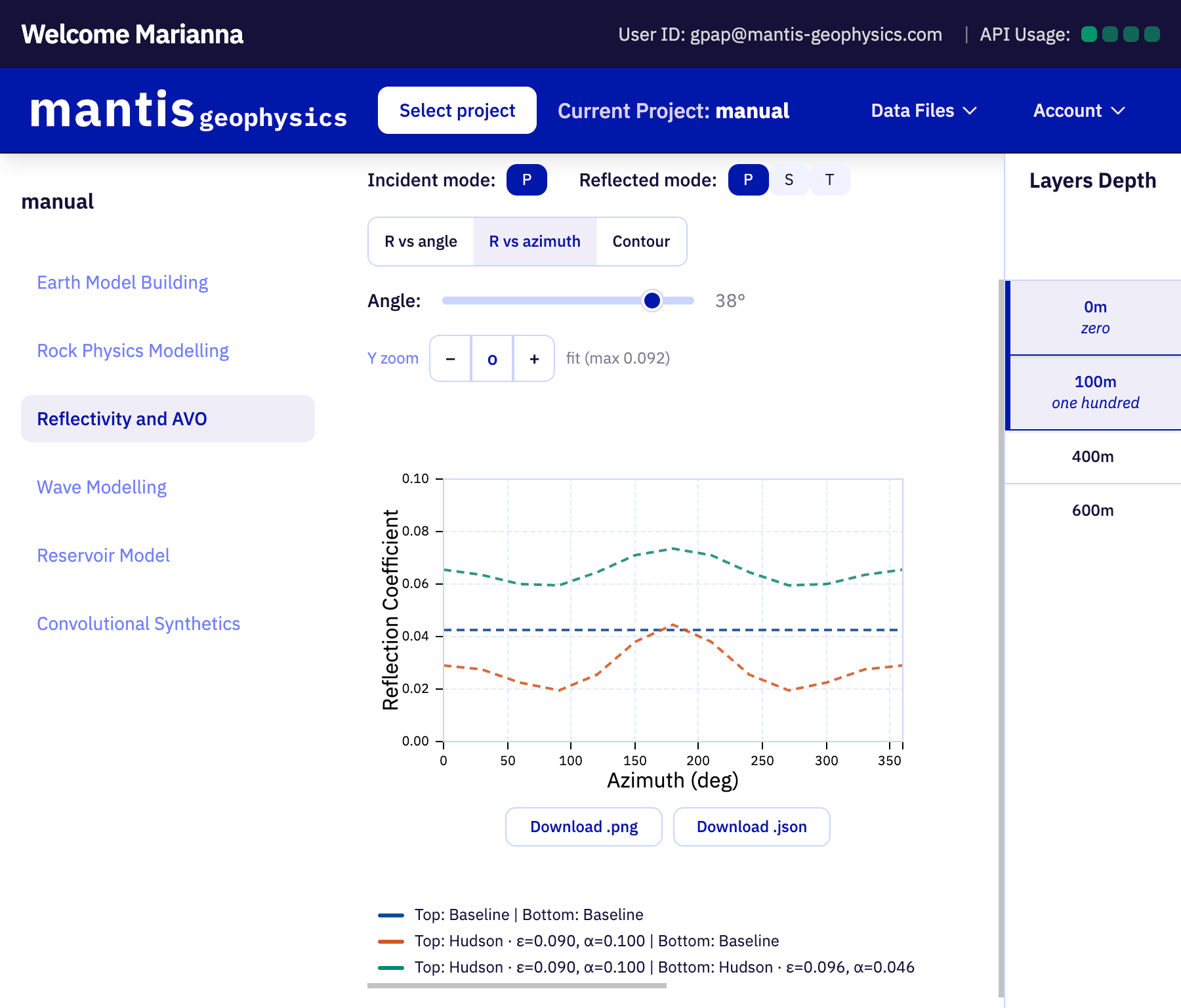
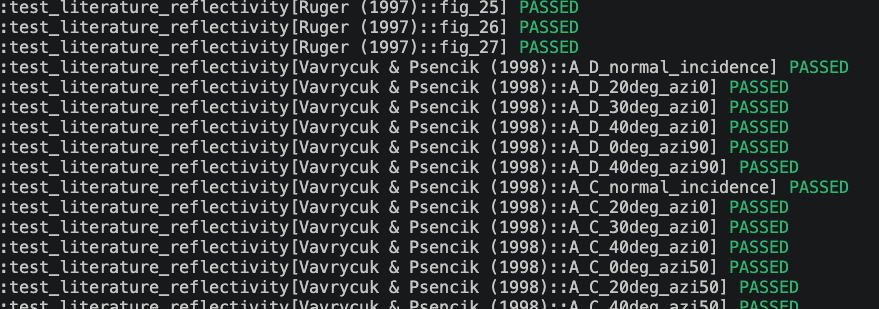
Our method is backed by extensive testing against published results of higher symmetries, generated by a variety of methods like ray tracing, linearisations etc. In some sense our test suite available through our web-based APIs is a product in itself. But more importantly, validation against published results gives us (and you!) confidence that the algorithm works as expected which in turn enables anisotropic simulations with very short runtimes.
… and what this means for VSP modelling.
Today we have a prototype that can simulate point sources of various signatures (vibrators, explosions, even shear wave sources) operating on a layer-cake 1D earth model with arbitrary anisotropy. A typical project workflow involves upscaling a well log, creating rock physics scenarios, and simulating walkaway or walkaround VSPs to see how anisotropy, fluids, acquisition geometry and single vs 3-component data affect the seismic signal and what can be inferred from it. And though we see many use cases for this engine, we especially want to hear from you if you’re operating (or planning) walkaround/walkaway VSPs. Check out the examples below to see what we mean.
Example: walkaround geometry with shear wave splitting
This simple three-layer Earth model with a fractured reservoir consisting of methane-saturated HTI fractures, demonstrates the effect of anisotropy on a walkaround geometry with clear shear wave splitting between symmetry planes.
qS arrivals down the receiver string, by azimuth and component
Example: walkaway geometry with a TTI reservoir
Here we model a ten-layer Earth with a tilted fracture layer. The key comparison to notice: how gas-saturated TTI fractures affect an isotropic equivalent with the same bulk elastic properties. The difference is dramatic! Above 1.0 km (above the reservoir) both runs are identical whereas below, the fractures generate off-plane energy that a purely isotropic model cannot capture.
Walkaway VSP shot gathers, by reservoir physics, shot position and component
What’s next?
We are currently working to enhance performance of this technology which we believe delivers full-triclinic VSPs in under 5 minutes. Our intent is to offer this alongside the rock physics, fAVO/AVAz and fully triclinic finite-difference products in our SaaS web platform before the end of the year. We would love to hear from you if you are interested in applying this technology in your current workflows or would be interested in gaining early access.