

Why “mantis”?
It all started at the downstairs booth of BrewDog in Edinburgh’s Lothian Road, while strategising how to write what ended up becoming a successful spinout grant bid (by the way, shoutout to Scottish Enterprise for their support during those early days!). We (Giorgos and Mark) had a problem: a spinout project needed a name and that name would stay with us when the company was formed
After a few beers and a long list of bad ideas, tacky puns and portmanteaus that have since been long forgotten (thankfully), one of us remembered an oatmeal comic about an animal unlike any other. A shrimp with an incredibly strong claw that delivers the most powerful and rapid punch in nature (an almost perfect impulsive source. When the punch is thrown, it creates cavitation bubbles much like an airgun!), that also possesses the most advanced optical instrument in the animal kingdom (a true broadband sensor), whose body looks like gray and black lines (very much like a stacked seismic section).
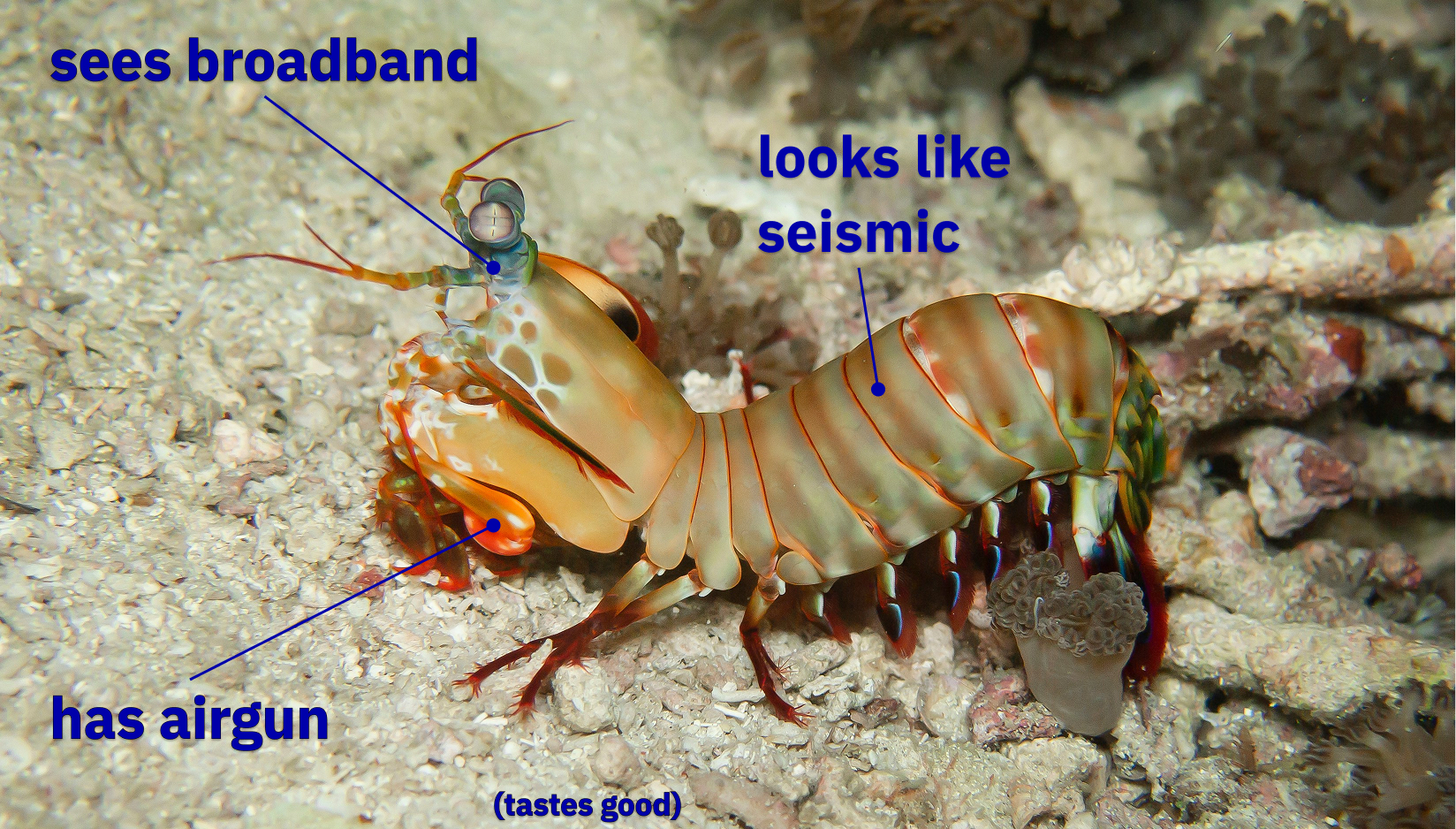
The decision was made: we’d name our company after the mantis shrimp. A year or so later we would also discover that it also tastes delicious but that is a story (involving Chinese hospitality) better left untold.
So yeah, it was not the preying mantis, nor Danny DeVito’s character from It’s Always Sunny in Philadelphia that inspired the name; it’s a flamboyant (did I mention tasty?) crustacean with one key feature: its broadband vision.
Why the logo?
If you’ve worked with attenuation intrinsic to rocks interacting with fluids, you’ll know that elastic waves disperse. That is, the stiffness of rocks depends on the frequency of the waves you throw at them!
In particular, this means that reflection coefficients at an interface between two distinct earth units have a spectrum, and that spectrum has both amplitude, but crucially also phase information. The phase of the reflection coefficient depends on many factors, but it can be written (sometimes exactly, sometimes approximately) as a function of two parameters: the maximum attenuation and a characteristic frequency. In most cases, if either of these quantities contrasts accross a horizon, then the reflectivity phase is non-zero. Which has repercussions in everything from thin layer resolution, fluid identification, permeability anomalies etc. Crucially, frequency/phase is another window into the data, another dimension for the crossplots, not something to be thrown out.
The same goes for anisotropy: a breadth of information, wave mode conversions and counterintuitive behaviours emerge when the assumption of VTI or linearised HTI media is relaxed. Tilted and non-orthogonal fractures have a rich azimuthal dependencies that can be used to identify fluid content so why isn’t azimuthal dependence (in its most general form) seen as a new dimension for data analysis instead of an afterthought?
We felts, linearising away anisotropy and attenuation was only in part due to data acquisition limitations but also, and perhaps crucially, due to limitations of the tools used for data analysis. If, we thought, a tool was to embrace rather than discard the azimuthal and frequency dependence of rocks and take them into account in modelling, inversion and interpretation workflows, then maybe we could start to see the data as it is, rather than as a simplified version of itself.
So we set out to create that tool starting with the modelling. And we gave mantis a logo that is three phased wavelets. “Three” because we embrace triclinic anisotropy, “phased” because we account for phase information.
Why the cloud?
But an idea is nothing without execution. A few months after the naming pub session, we (Giorgos and Alexis) found ourselves in a very similar setting, this time at the malt whisky society. This was going to be a simpler chat: Alexis was going to give us a couple of pointers on how to deploy our technology and make it available to the world, ideally saving us the capex of buying infrastructure. How hard could it be?
Some pointers turned to a discussion, then a half-day, then a full day (by this stage we stopped meeting at pubs - it was unsustainable), followed by a week, a month, six months, whiteboards, learning new tools and so on and so forth. By the end of the year Alexis would join as co-founder when we registered the company, and we now have a true serverless cloud-based rock physics and simulation product. On-demand, scalable and secure. Geophysical APIs and a web-based interface that can be used by anyone, anywhere, on any device. An arbitrary anisotropy reflection coefficient solver, a primaries engine that can handle model-based attenuation, a phased sparse reflectivity inversion solver, and an MPI-based triclinic anisotropic 3D finite-difference modelling engine, all running on the cloud. We’ll be following this post with details on how we use these tools in applications from CO2 monitoring to reservoir characterisation so do follow us on LinkedIn.
Why us?
We are extremely passionate about what we do. We have a deep understanding of the physics of seismic waves and how they interact with rocks, and we are committed to pushing the boundaries of what is possible with seismic simulation and data analysis. We are also committed to making our technology accessible to everyone, regardless of their background or expertise. Next time you are told that “anisotropy is a second-order effect” or that “phase is not important” ask yourself: is that because of the physics of the problem, or because of the limitations of the tools we have been using for decades? Then get in touch with us.